
Australian-Ukrainian Cardinal Mykola Bychok CSsR’s earliest experiences of the Church were with his parents at secret liturgies held in hidden rooms to avoid detection by Soviet authorities in the 1980s, reports The Catholic Leader.
Cardinal Bychok, 46, now stands among the highest ranks of the Church after his elevation by Pope Francis in 2024.
He is also the youngest cardinal in the world.
He shared his journey in an interview with 55Comms director Michael Crutcher at a fundraising event for the restoration of Toowoomba’s St Patrick’s Cathedral recently.
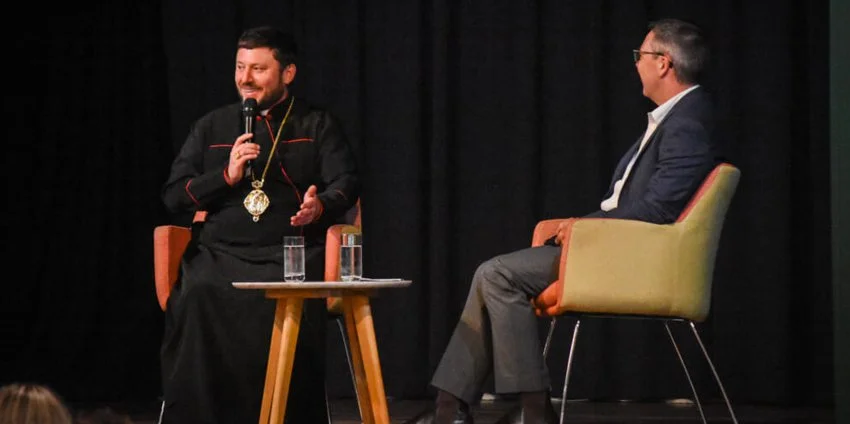
Cardinal Mykola Bychok CSsR in conversation with Michael Crutcher at a fundraiser for the Diocese of Toowoomba recently. PHOTO: Diocese of Toowoomba website.
The son of a roadbuilder, Cardinal Bychok once dreamed of becoming a cosmonaut or a musician.
Those dreams took a back seat when a religious sister pointed him out in a crowd.
His upbringing in the Church was stifled by the necessary secrecy.
“It was impossible to express your faith,” Cardinal Bychok said.
Cardinal Bychok said his early years were “really simple” with no obvious sign he would one day become a priest or a cardinal.
Beyond the religious restrictions, the Soviet regime suppressed Ukrainian tradition and culture.
Basic items common in the West were non-existent; he recalled that he did not even taste his first banana until he was 14 years old and things like Coca-Cola were entirely absent.
He had not been going to Mass regularly as a child, but he remembers one Epiphany feast, his parents had taken him along and as it happened, there were no altar servers.
“So, one sister pointed me out and said, ‘You go here’,” he said.
“After this calling of the sister servant, I began to visit every Sunday.”
From there, he had a run of wise spiritual teachers who inspired him with their stories of serving the Church through times of Soviet persecution.
The Soviet Union officially pursued state atheism and aimed to eliminate religious beliefs, including through persecution and surveillance.
His path eventually led him to the Redemptorist order, a group dedicated to serving the poor and forgotten.
He spent his school holidays on missions with them and began to envision his life as a priest, feeling a call from God.
He was ordained in May 2005 and spent time in his early priesthood in the western part of Siberia, where temperatures could reach minus 50 degrees Celsius.
He remembered celebrating a funeral, arriving at the grave side and the holy water had frozen mid-blessing.
After the fall of the Soviet Union, intelligence agents remained a looming presence.
He said it made ministry difficult because there were many “agents chasing us”.
“That was the reality of Siberia,” he said, though he called it the “blessed time” of his life for the resilience he witnessed in persecuted believers.
The cardinal’s life took a surreal turn on October 6, 2024, when he was dining at a pizzeria under the Story Bridge in Brisbane.
With his phone muted, he was unaware that Pope Francis had just announced him as the youngest member of the College of Cardinals.
He said he could not believe it.
“What is going on?” he said when he saw the missed calls.
His elevation was followed shortly by a historic transition for the Church.
Following the death of Pope Francis last year, Cardinal Bychok participated in the conclave that elected Pope Leo XIV, formerly Cardinal Robert Prevost.
Cardinal Bychok described the so-called room of tears where the new Pope wept upon his election.
As the voting count reached the required 89 in the Sistine Chapel, Cardinal Bychok observed the future Pope praying, weeping and looking toward the famous Last Judgment scene.
Cardinal Bychok said the new Pope’s first message to the world was “Peace be with you” (Pace), and he expected him to be a “huge peacemaker” in global conflicts.
However, the weight of the ongoing conflict in Ukraine weighs heavily on Cardinal Bychok.
Now in the fifth year of a full-scale invasion, Cardinal Bychok painted a grim picture of a nation where two million veterans were returning home and more than 100,000 people remained missing in action.
He criticised the “enormous” use of Iranian drones by Russia and noted that many Ukrainian children had not seen the inside of a classroom for five years due to the constant threat of aerial strikes.
“Without faith, it’s impossible to stand,” Cardinal Bychok said.
He said nearly every Ukrainian soldier now carried a rosary into battle as a “special sign of the presence of God”.
As the Church looked toward the future, Cardinal Bychok confirmed that Pope Leo is expected to visit Australia in 2028 for the Eucharistic Congress, an event the Cardinal hopes will bring a “renewal” to the faithful in the region.
This article by Joe Higgins was published in The Catholic Leader, the publication of the Archdiocese of Brisbane.