
A cloud of happiness surrounds a group of volunteer gardeners taking a well-earned tea break after harvesting a crop of vegetables destined for a nearby soup kitchen from the Jesuit Social Services’ Ecological Justice Hub in Melbourne’s Brunswick, reports Melbourne Catholic.
The place is a fine example of the principles of Pope Francis’ encyclical Laudato si’, where the call for environmental stewardship intertwines with a nurturing of humanity. Here, ‘care for the planet, care for the poor’ is heeded at the local community level in a practical and genuinely accessible way.
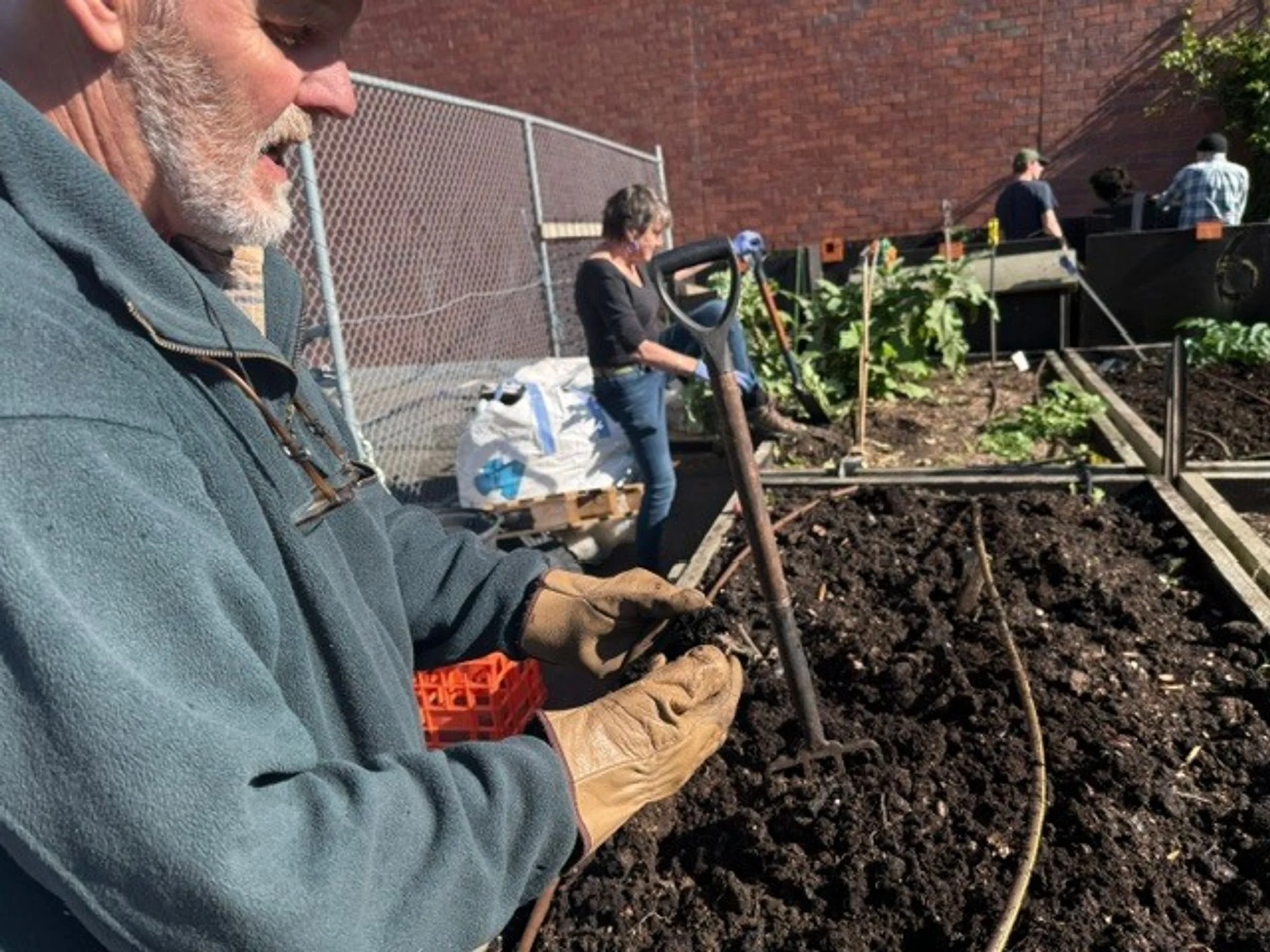
Senior project adviser Mick McGarvie demonstrates the quality of compost at the Jesuit Social Services Eco-Hub. PHOTO: Melbourne Catholic.
It is an unusual setting for a garden, set on the basketball court of an old primary school. The raised garden beds sit right on the asphalt, but the constant digging-in of rich compost and mulching of the plants counteracts the harshness of the ground beneath. The greenery is cooling and emits a fresh, clean scent throughout the hub.
Senior project adviser Mick McGarvie explains the hub’s approach, capturing both its purpose and its scale.
“Jesuit social services generally deals with addressing disadvantage in the community through social means, but it also wanted to find ways of addressing disadvantage through environmental or ecological means,” he says.
“Several years ago, we established this operation to deal with ecological justice—that is lack of access, lack of knowledge, lack of understanding, lack of resources. So, this is a teaching operation, it’s a place of demonstration, a place of social interaction. And it’s a place that recognises others performing social services as well.”
He describes the everyday rhythm of the work as revolving around the neighbourhood’s needs.
“For example, we grow food and harvest it seasonally and take it every Tuesday over to the Uniting Church, which has a kitchen that feeds rough sleepers and lonely people. They do like our fresh garden greens! They get a lot of variation through the year, but we’re able to supply them with one or two boxes of fresh garden greens each Tuesday.”
This week, volunteers harvested rhubarb and micro greens for the Olive Way kitchen on Sydney Road. As Mick explains, the Uniting Church’s hospitality centre gets other food donations but very little fresh produce. And the freshness of the Eco Justice Hub’s crops cannot be beaten, being in the ground at 9am and on the table by noon.
The bounty is the result of hard work and carefully planned cultivation. Their compost is made on site from carefully shredded green waste, coffee grounds donated by Reground—which collects from cafes across Melbourne and donates to “anyone who’ll make it into compost”, Mick says—and sawdust from a local furniture maker. Seedlings are grown in the greenhouse before being transferred to the garden beds. Snails are not a problem, as they’re unable to navigate the asphalt surroundings to get to the delicious plants.
Neighbours drop in their food scraps which are finely chopped up with sawdust, which then goes either into the worm farm or into the biodigester that provides food for the mini biogas plant.
Mick bought the plant online and taught himself how to operate it. Bacteria in the food waste and water slurry form methane gas which collects in a tough canvas bag. At full expansion, Mick says, it contains 60 litres of gas which can last on a low flame for about eight hours—ideal for cooking a soup or casserole. The hub uses it to power the kettle the volunteer gardeners gather around for their convivial cup of tea.
Ben Walta is the advocacy and engagement officer for the Jesuit Conference Asia Pacific, based at the hub in Brunswick. He says that later this year, the hub will host a Timorese farmer, Joaninho, who will be visiting as a guest of a Timorese–Australian friendship group. Ben hopes to be able to demonstrate how the biogas generator could be repurposed in Timor-Leste, where smaller villages often have unreliable power sources.
Looking beyond the local neighbourhood is part of the Eco Justice Hub’s evolution, Ben says.
“The Eco justice hub has been a demonstration and experimental site for about the last six or seven years,’ he explains, outlining projects like plastics recycling and COVID-era food relief, as well as the biogas production, and the all-important seasonal food production,” he says. “We’re inviting new partnerships and engagements with the community, too.”

Volunteers at the Jesuit Social Services Eco-Hub have a cup of tea together. PHOTO: Melbourne Catholic.
One emerging project is around propagation called Greening Hearts, Minds and Neighbourhoods.
“[This] will be propagating small seedlings and plants available to a wider community. That’s also about [addressing] the heat island impacts of extreme heat events.’
The Artful Dodgers Studio adds another layer to the site. The studio works with at-risk young people, offering drop-in sessions and workshops.
The coordinator, Michelle Dabrowski, says the goal is to create a safe and easy entry point to wider social services.
“We run a multidisciplinary art studio for young people aged between 16 and 28, and specifically catering to young people experiencing psychosocial, intersectional life challenges,” she explains. As well as drop-in sessions, they run skilled workshops, and they change week to week based on what the young people want to do and what’s trending.
“It’s a safe third space for young people to just feel that they can exist. We’re providing different creative and mindful practices that help take the focus off of their problems and to kind of help create different neural pathways to help them maybe find seek a different avenue or a solution.”
Michelle talks about slowly integrating the Artful Dodgers into the garden with the intention of collaboration between the two spaces in the future. This gels with other plans for the Eco Justice Hub, which Ben says aims to be practical as well as hopeful.
“This space will become more of a gathering space for different groups. If anybody wants to get in touch, we’re open to good conversations,” he adds.
The hub is also changing physically as the space opens up for more gatherings and community activity. They are leasing an old house owned by the Archdiocese of Melbourne and moving the biogenerator into its adjoining backyard. In the future, it might be moved again to a street front to demonstrate the possibilities of community biogas centres to passers-by.
This hub of neighbourhood greening and community connection is an authentic representation of the values of Laudato si’. The people that make the Eco Justice Hub show how with creativity, generosity and warm community relations, an inner city patch of bitumen can, in the words of Laudato si’ transform an environment ‘into the setting for a dignified life’ (§148).
This article was published in Melbourne Catholic, the publication of the Archdiocese of Melbourne.