
The heart of Western Sydney beat with a singular rhythm of grace on the evening of February 24, as the region’s many faiths came together to listen to others and celebrate what unites them, reports Catholic Outlook.
Hosted by the Interfaith Commission of the Diocese of Parramatta, in close partnership with the Columban Centre for Christian-Muslim Relations (CCCMR), the 2026 MultiFaith Community Iftar Dinner was a unifying example of spiritual convergence.
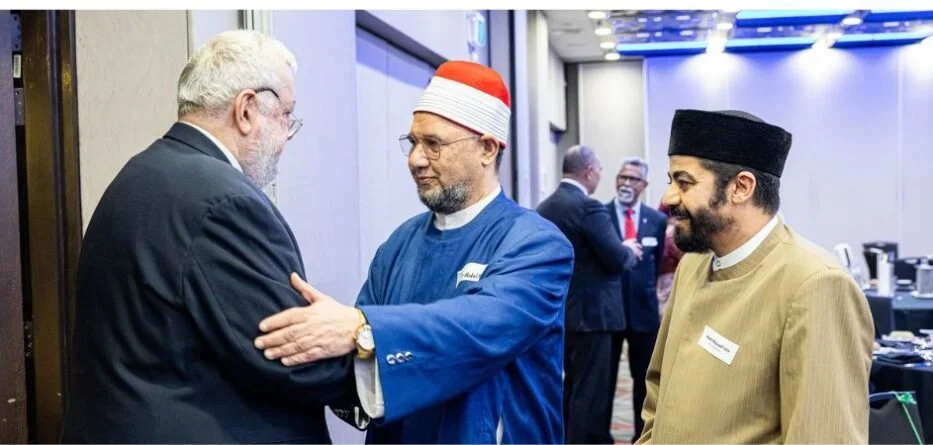
Fr Patrick McInerney SSC, director of the Columban Centre for Christian-Muslim Relations, greets visiting Imam Fawzy Abdel Baqi, at the 2026 Iftar Dinner while Imam of the Parramatta Mosque Mosaad Issa, looks on. PHOTO: Alphonsus Fok/ Diocese of Parramatta
This year the event took place in a rare and holy overlap. As the Muslim community observes the fast of Ramadan, the Christian community is journeying through Lent. This alignment provided a profound backdrop for the gathering, reminding those gathered that while their paths may differ, their hunger for the Divine – expressed through prayer, fasting, and almsgiving – is a journey they share.
In addition to Muslim and Christian guests, the Bishop of Parramatta, Bishop Vincent Long Van Nguyen OFM Conv, and the Director of CCCMR, Rev Dr Patrick McInerney SSC, welcomed a diverse group of faith and community leaders, friends, and neighbours from the Baha’i, Hindu, Jewish, and Sikh traditions. Politicians from all levels of government were also in attendance, including federal MPs Chris Bowen and Michelle Rowland, state MPs Donna Davis, Julia Finn and Lynda Voltz, and local councillors Patricia Prociv, Sameer Pandey and Susai Benjamin.
As the sun dipped below the horizon, the hauntingly beautiful call of the Azan by the visiting Imam from the Parramatta Mosque, Fawzy Abdel Baqi, filled the space. In that moment of hushed respect, guests stood in solidarity, witnessing the deep devotion of our Muslim friends as they broke their fast.
Bishop Vincent and Fr Patrick reminded those gathered that in Australia’s most vibrant multicultural region, peace is built through daily interactions. It is found through encountering one another: the shared dates, the passed water, witnessing the Maghrib prayer. It is found in the stories exchanged between strangers who leave as friends.
Bishop Vincent told the audience that the annual Iftar Dinner was “a sign of commitment on the part of the Diocese of Parramatta to promote a culture of encounter, dialogue, understanding and solidarity in Western Sydney, which is the epitome of multicultural, multifaith and ethnically diverse Australia”.
He said in this holy month of reflection for Christians and Muslims it was especially important to remember those who had been affected by conflict and disaster.
“This sacred time reminds us of our common obligations to uphold the dignity of every human being, to make peace, to nurture goodwill and to facilitate unity in the face of economic and social inequality and fragmentation” he said.
In his welcome address, Fr Patrick noted that hatred, violence and division between religions is an increasing feature of the world. But he reminded the audience that the Catholic Church had an answer 60 years ago for how Christians should view other religions. In Vatican II’s document Nostra Aetate, it says: “The Church regards the Muslims with esteem”.
Therefore, he said, “Esteem, high regard, respect, affection, appreciation, acknowledgement, mercy and compassion – these are the values that should inform our relations with Muslims, and with Jews, Baha’is, Buddhists, Hindus, Jains, Sikhs and people of all faiths and worldviews”.
Kate Xavier, the Chair of the Diocesan Interfaith Commission, said the Iftar Dinner was an opportunity for people of different faiths to meet and connect, and that this was “uplifting and hopeful”.
“We hear about the lives and experiences of the other and find ways to connect, learn and support the other,” she said.
The keynote speaker was Mr Osman Karolia, a respected community leader, educator and humanitarian dedicated to strengthening civic participation, interfaith collaboration, and social cohesion across Western Sydney. As Principal and CEO of the Islamic College of Sport in Sydney, Osman spoke of his work in educating the next generation of young Muslim Australians to become vibrant active members who serve the wider Australian community.
He said at his school, students engage in initiatives “such as our homeless outreach program, grocery distribution to families in need, caring for the environment, engaging with the elderly and young people living with a disability”.
“When we serve, we serve all of humanity, we don’t ask people of their faith, nor propagate ours,” he said.
“Tonight, in this room, we see the best of Australia. We see Muslims and non‑Muslims, people of faith and people of none, elected representatives, community advocates, and families sitting together in friendship.
“We see leaders who understand that harmony is not achieved by ignoring our differences, but by honouring them. We see a community that knows the antidote to hate is not silence—it is connection.”
Inspired by the spirit of human sorority and fraternity, the 2026 Iftar Dinner reaffirmed the local commitment to standing against social division. Participants were urged not to leave this spirit behind in the dining hall, but to carry it into the streets, workplaces, and parishes.
By prioritising the common good, this gathering proved once again that religious diversity is not a challenge to be managed, but a source of immense social strength and a blessing to the wider Australian community.
This article by Kim Chong was published in Catholic Outlook, the publication of the Diocese of Parramatta.