

Sr Mary O’Shannessy singing hymns with children with disabilty. PHOTO: FCJ Sisters via Melbourne Catholic.
Ignatian spirituality invites believers to enter the gospel stories with their senses, to be there with Christ in the scenes of his life and death. But for two legally blind, Ignatian-inspired religious, when their own formation encouraged them to ‘picture’ Jesus surrounded by thronging crowds, or to ‘see’ the landscapes he walked through, they found they needed to reframe St Ignatius’ method, reports Melbourne Catholic.
Fr Justin Glyn SJ and Sr Mary O’Shannessy FCJ both grew up navigating the world without relying primarily on vision. Now, drawing on their personal experience and pastoral practice, they have adapted Ignatian contemplations so they can be prayed by people with diverse sensory and cognitive experiences, including those who may not read or process language easily. Their adaptations have evolved into an ongoing project, We Walk By Faith: Accessible Spiritual Contemplation for All, a series of written and audio contemplations.
“The point is that we’re trying to open these things to people who wouldn’t necessarily read the exercises or pray the exercises themselves,” Fr Justin says. “We’ve actually had to reimagine the stuff for ourselves to pray it properly. So what would that be like for other people? And can we make this something that will be useful for more people?”
Fr Justin, a Jesuit civil and canon lawyer, describes his own prayer life as one rooted in non-visual senses. “I tend to work a bit on physical senses like smell and hearing,” he says. “I find smells instantly evocative; a smell will bring me back to a place that I haven’t been in in decades.”
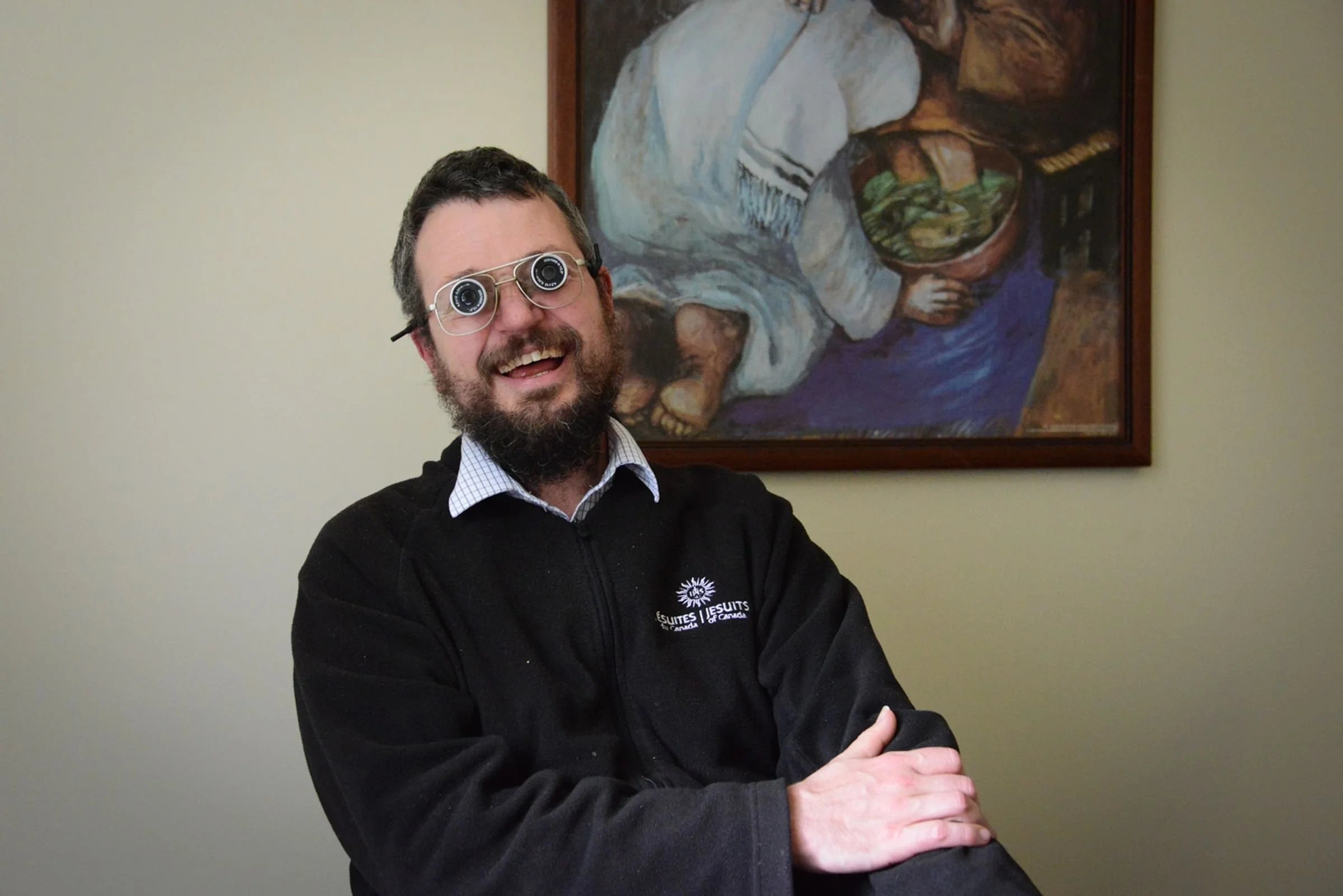
Fr Justin Glyn SJ. PHOTO: Fiona Basile, Melbourne Catholic.
Sr Mary, a retired teacher and pastoral care coordinator, is more about the internal and the interpersonal. “I don’t concentrate so much on the other senses,” she explains. “I concentrate particularly on hearing and seeing my inner feelings and how I react, and on picking up vibes from other people.”
The obvious friendship between the two and a mutual respect play a big part in why the partnership works. Sr Mary jokes that as she has some peripheral vision and Fr Justin has, with the help of telescope glasses, some central vision, between them they have ‘normal’ sight.
Their work is equally complementary: contemplations from the narrative passages of the synoptic gospels are divided into sub-categories: ‘Rest a while’ (Fr Justin’s shorter, descriptive pieces) and ‘Stay a while’ (Sr Mary’s lengthier, free-flowing pieces). They offer what they describe as “a gentle and accessible introduction to the gospel scene,” followed by a set of thought-provoking questions to aid prayer and conversation with Jesus.
“Ignatian spirituality grounds the story in something that we can understand instead of talking about things that we may not know,” Sr Mary says. She invites the reader to become a character in the story, giving as an example of how she might do that the story of the haemorrhaging woman seeking to be healed by Jesus. “‘I’m in the crowd, and you know, it’s really crowded. I’m bumping into everyone, and it’s hot and sweaty. I don’t want to get away from Jesus. I want to hear what he’s saying. And there’s this woman who keeps on pushing up forward, trying to get to Jesus. What is she doing?’—that sort of thing,” she says. “I might be the woman who is touching Jesus’ cloak and I’m frightened, and I can get into that.”
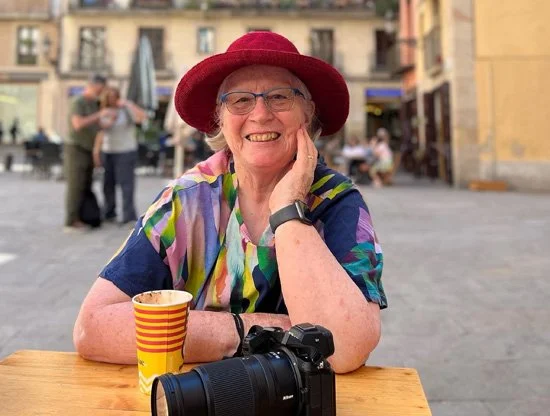
Sr Susan Daily CJ, whose artworks feature in the resource. PHOTO: Supplied (via Melbourne Catholic)
“I assume you’re just you,” says Fr Justin, explaining that he writes as though the reader is there with Jesus. In one example, from Matthew (4:1–11), he writes of the temptation of Jesus, where ‘we’ are in the wilderness with him. After a simplified retelling of that passage, readers are encouraged to ponder what Jesus is going through and how they deal with feeling alone.
The guiding questions are far from trivial, and the reader still has to put in the work to answer them. But the whole project is welcoming and respectful of the different ways people contemplate God. Its accessibility is further widened through the ongoing recording of each contemplation into mini podcasts, accompanied by stunning illustrations by artist and Loreto Sister Susan Daily CJ. Fr Justin has engagingly voiced his, while Sr Mary’s are still in the pipeline.
Their work challenges the way disability is seen, but also brings up personal issues. They recall how certain Scriptures, particularly healing miracles, can be alienating and even painful for people with disabilities. They point to the Gospel of John, chapter 9, where the disciples assume a man’s blindness is a punishment for sin. “Those kinds of readings of disability as being associated with sinfulness or problem—for those of us who have disabilities, that stuff can be a text of terror. ‘Well, you’re blind. Why aren’t you healed? What did you do?’” Fr Justin says.
Both have faced the assumption that their blindness is a problem to be solved or something to be pitied. They separately had immense difficulties because of it. Fr Justin describes growing up in Apartheid-era South Africa as an unbelievably brutal time. Yet he also gained payoffs, such as an exceptional memory and a talent for music and languages.
Sr Mary’s entry into religious life was a battle to prove blindness would not hamper her. It gave her a unique perspective and a deep well of empathy for others on the margins, and now she says she would not change a thing. “I’d have to think carefully if I were to ask for my full sight, because this is the way I am, and it affects everything,” Sr Mary says.
She worked throughout her career with children and adults with disabilities, and looks back on those times with gratitude. “People with disabilities [are] a tremendous gift, because they call forth help from other people. You know, there’s an awful lot of good in them, and I don’t think we always realise that.”
Disability is part of the human package, Fr Justin says, but society’s obsession with ‘perfect’ bodies can give rise to the notion that some lives are worth less than others. “Everybody’s limited,” he says. “You don’t get perfection this side of death. Jesus had to be born at a particular time, place and gender—disabilities are just part of those packages of contingency of what it means to be a person.”
These insights have coloured We Walk By Faith, with its express mission to ensure others are not excluded from developing a rich spiritual life. Through their writing and podcasting, Sr Mary and Fr Justin are opening the doors of Ignatian spirituality, ensuring that the ability to ‘picture the scene’ is available to everyone, regardless of how they see.
This article was published in Melbourne Catholic, the publication of the Archdiocese of Melbourne.