
Cardinal Charles Maung Bo SDB, Archbishop of Yangon in Myanmar, and Cardinal Mykola Bychok CSsR, the leader of the Ukrainian Greek Catholic Church in Australia, have highlighted how important faith is in times of war to get through the crises and begin the process of healing, reports Melbourne Catholic.
The two cardinals were speaking at a discussion facilitated by Catholic Mission and the Xavier Social Justice Network, titled ‘A Dialogue for Peace, Humanity and Justice’, at Xavier College, Melbourne, on May 5. Also on the panel was Catholic Mission’s director of programs, Lawrence Gigliotti, and it was moderated by Catholic Mission’s schools engagement coordinator, Rachel Prince.
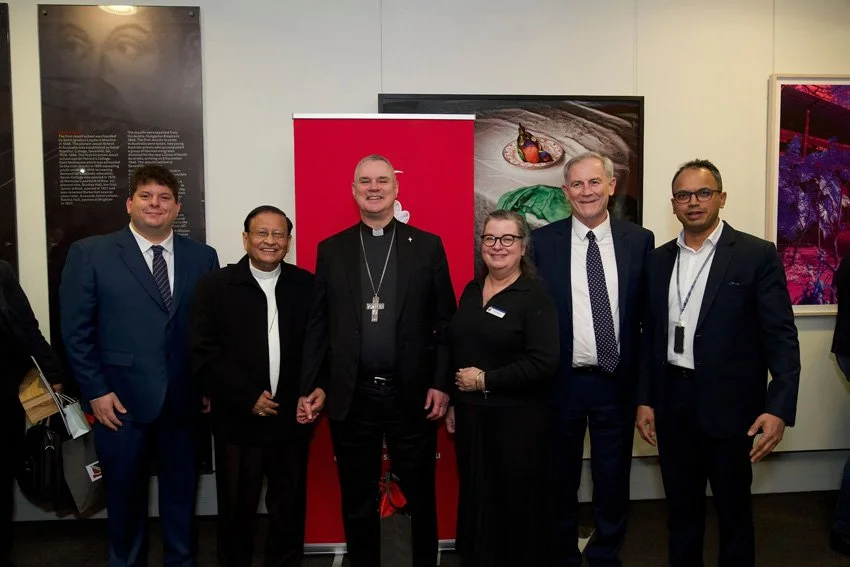
From left: panelist Lawrence Gigiliotti, Cardinal Bo, Archbishop Comensoli, Chancellor of the Archdiocese of Melbourne Annie Carrett, Catholic Mission National Director Peter Gates and Catholic Mission Province Director Cruz Ignatius. PHOTO: Melbourne Catholic.
Archbishop Peter A. Comensoli opened the evening with a call to action that set the tone for the discussion. He spoke of a world marked by division and the urgent need for builders of bridges. “Bridges do not erase differences; they span them,” he said. “They require strength, patience and courage, and they then need to be walked across in a time when it is often easier to retreat into what is familiar or to reinforce what divides us.”
Cardinal Bo described Myanmar as being in a situation he calls a “polycrisis”—a convergence of political, economic and humanitarian emergencies that overlap and reinforce one another. “Since 2021, Myanmar has been facing political instability and violence,” he said.
“Economic collapse, inflation, unemployment and poverty have increased sharply, leaving many families struggling for basic survival, even ... for drinking water.”
He spoke of a Church under pressure, yet remaining one of the few institutions still trusted by the people. “The Church has become a frontline responder, providing shelter of displaced persons, offering food, medicine and education, acting as a voice for peace and justice.”
Cardinal Bychok described a different but equally devastating landscape in Ukraine, which was invaded by Russia in February 2022, but has been effectively at war since Russia’s annexation of Crimea in 2014. War, he said, is a physical and spiritual injury.
“We are wounded by wars, but we should remember that we are not alone,” he said. “Everyone is wounded by this war, but it allows us, in cooperation with Christ, with God’s grace, to be healed.”
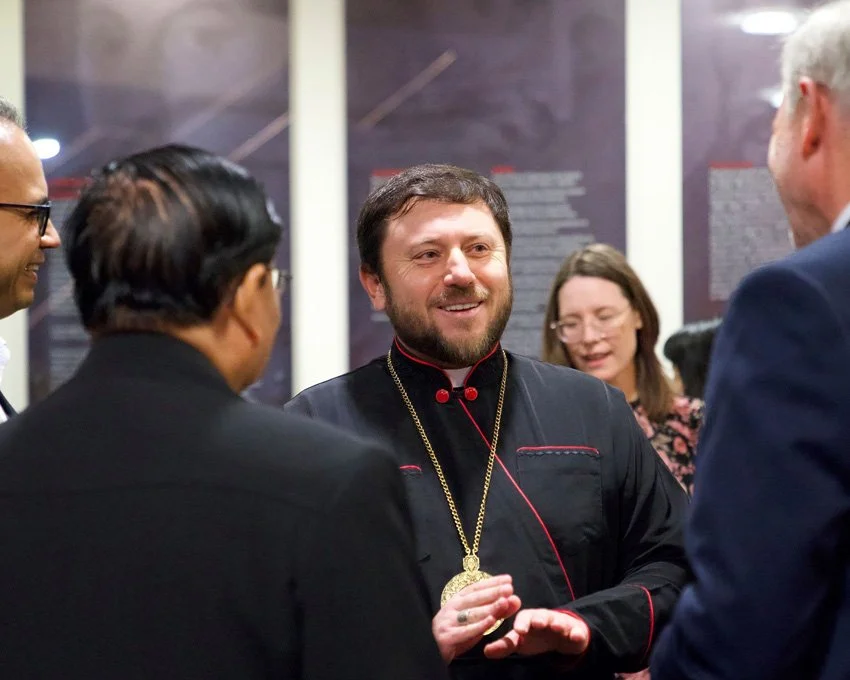
Cardinal Mykola Bychok CSsR at the event in Melbourne. PHOTO: Melbourne Catholic.
A striking moment, apt for the Easter season, was Cardinal Bo’s description of hope in Myanmar as being both crucified and alive. It is a powerful paradox, he said, that captures both the deep suffering people endure and the stubborn resilience that refuses to die.
“Hope is crucified when the forces of life are publicly wounded, humiliated and made it to seem powerless,” he said. “When the people cannot live safely, hope feels nailed down by fear.” He spoke of the despair of young people and the “suffocation” of dreams. Yet, he insisted that the story does not end at the crucifixion.
“Myanmar today lives in a kind of Holy Saturday moment. The pain of Good Friday is real and visible, but the promise of Easter is already quietly at work beneath the surface,” Cardinal Bo said. “Hope is wounded, but not buried. The enduring image will be [that] hope in Myanmar today is like a candle in a storm. The wind lashes, it bends it, nearly extinguishes it, but it continues to burn.”
Lawrence Gigliotti raised ‘accompaniment’ as a practical example of hope. He shared stories of young people in Myanmar who, despite having never seen an aeroplane or a telescope, dream of becoming pilots and astronomers. ‘I have hope. I have dreams,’ he recalled a student saying.
He spoke of seeing first-hand the Catholic Church at work in countries like Myanmar and Cambodia, whose Catholic populations are a religious minority. ‘They are batting well above their weight in education, in health care, in supporting people to have a better future. The Church in all of these places is working, not just with Catholics, but with everyone.’
The Church is building bridges by speaking truth without hatred, serving without discrimination, listening without judgment, remaining present when others withdraw.
This sentiment was echoed by Cardinal Bychok, who spoke of the impact of simply “showing up”. He recalled a group of Australian bishops, including Archbishop Comensoli, attending a funeral in Ukraine. When the grieving family realised the bishops had come all the way from Australia, it was “not like words of hope, [but a] special sign of hope”.
The dialogue ended with an audience question about the concept of ‘just war’. Cardinal Bychok turned it around to ask about ‘just peace’. Peace without justice is merely a pause in violence, he said.
“Without truth, there will not be the just peace and true peace,” he said. “We know this from our history ... This war was frozen, just only for few years, and then with new forces, full-scale invasion. And right now you see, from a small fire can be a huge fire, can become a disaster.”
He challenged world leaders to rediscover their humanity and “to be open to the discussion, to the dialogue you should have. You should be humble, not proud. You are not God. You are human. You see, sometimes world leaders, they are losing these connections”.
During his time in Australia, Cardinal Bo spent time with a number of different faith communities, including the meeting of the Australian Catholic Bishops Conference and a visit to the Catholic Religious Australia secretariat in Sydney.
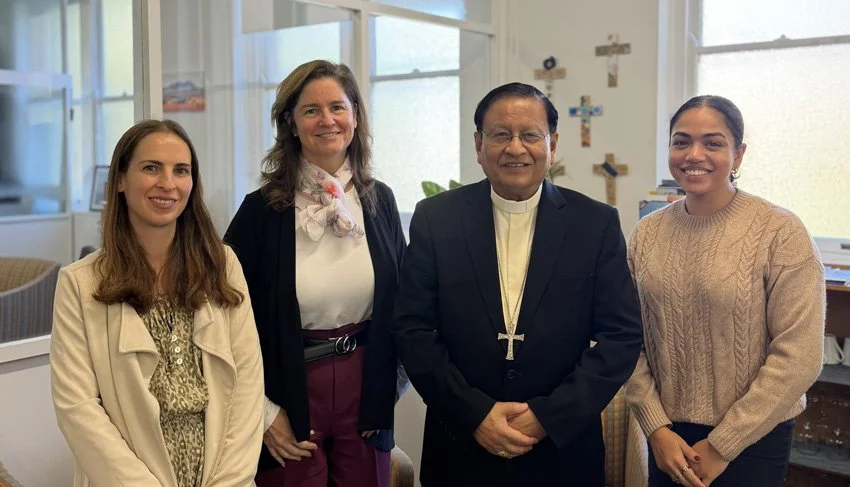
Cardinal Bo during his visit to the CRA secretariat with, from left to right, Emma Carolan, Anne Walker and Taylor Coutinho. PHOTO: CRA
This article is drawn predominantly from an article published in Melbourne Catholic.