
Father Dave Ryan SJ recently marked 50 years since he entered the Society of Jesus, with a quiet sense of gratitude for the people and places that have shaped his life, saying the anniversary simply sharpens his awareness of the hope he sees every day at St Canice’s Parish in King’s Cross.
Fr Dave witnesses young people finishing school with uncertainty about their future, yet possessing a willingness to step outside their comfort zones. Many of them undertake “immersions” overseas—placements in non-profit or community organisations such as the Colombiere Social Enterprises offered by St Canice’s, where they encounter different cultures and different realities. They return to Australia, study or train, and often choose to go back to those communities or continue similar work locally. Being a witness to this process gives him confidence in the Church’s future.
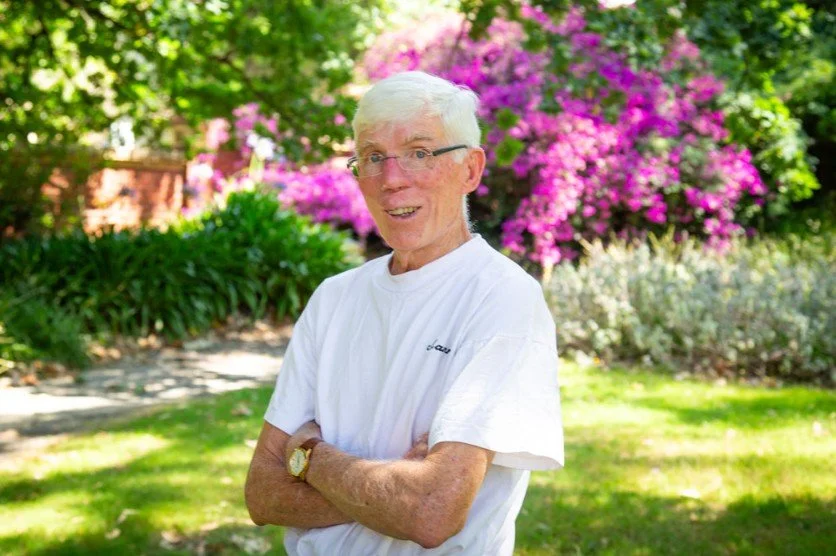
Fr Dave Ryan SJ (PHOTO: Janark Gray, Australian Jesuits)
“That’s what gives me hope,” he says. “Young people wanting to do something else before they get into their career. Volunteer with acts of service, and from that making life decisions—about work, and their relationships.”
St Canice’s Kitchen plays its own central role in the community, open six days a week for people who need a meal and who also need a place to belong.
His path to the Society of Jesus, however, began far from King’s Cross. He grew up in the regional city of Wagga Wagga, New South Wales – the eldest of eight children in a family whose drycleaning and laundry business had serviced the local farmers and hotels. His grandfather, the business owner, died of a heart attack at aged fifty. This compelled his father (living in Sydney at the time with his mother) to move back to Wagga Wagga to take over the role.
The family’s story folds into a broader network of priests, religious sisters, cousins and extended relatives who shaped young Dave’s understanding of vocation long before he could name it. Some were Presentation Sisters teaching in the area; others were Diocesan priests connected to Wagga Wagga. One of them, Ralph Fitzgerald—who held a pilot’s licence and served in New Guinea—planted seeds of curiosity in the young mind of Dave about vocation and missionaries.
Boarding at Saint Ignatius’ College Riverview gave him rugby, sport, and exposure to Jesuit life, but university took him to Canberra, where he followed a close friend into law studies. The reality, he jokes, is that he was more a successful backpacker than a successful student. He soon realised Law was not for him and decided to travel and see the world. A stint on a kibbutz in Israel saw him caring for dairy cows on a feedlot in a dry landscape with no paddocks—feeding them, cleaning after them, and learning from fellow volunteers. Then came many journeys across the United States in Greyhound buses, culminating in a moment of clarity somewhere between the towns of Blytheville and Sikeston. “Time to go home, Dave,” he told himself—not only home to Australia, but toward something deeper. He had previously travelled through Mexico, before venturing through the U.S. and Canada and heading over to London. He flew from London back to Australia and soon after applied to join the Jesuits. He entered the Society in 1976 at the age of 22.
Formation brought structure—social work, nursing-type experience, teaching—all elements of the Jesuit novitiate. It also brought lifelong friendships. The ten men who entered with him remain in close contact, including Fr Michael Smith SJ and Fr Chris Middleton SJ. They are looking forward to meeting again at a Jesuit retreat in Gerroa this July.
His studies were not always easy. “I found that daunting,” he admits. He asked for help, received it, and passed. It was an experience that taught him a lesson he now applies to pastoral life: what seems impossible often becomes possible when shared.
After ordination in 1987 in Wagga Wagga, he was sent first to Townsville and shortly after to Darwin with fellow Jesuit Fr Patrick Mullins SJ, who was beginning ministry among urban Aboriginal communities. Fr Dave, however, was invited to serve across the water in the Tiwi Islands, on Bathurst Island and Melville Island, and also at Nungalinya College. There he taught scripture to future church leaders from across the Northern Territory, Queensland, and Western Australia. The top end was formative. He grew to admire the Tiwi people deeply. “Tiwi means ‘we the people,’” he explains, noting that unlike many Aboriginal communities on the mainland, the Tiwi have never been dispossessed.
A later assignment took him to a desert community in Western Australia, where he ventured out of his comfort zone. Without fluency in the local language of Gugaja, he felt unable to serve as effectively as his predecessors Fr Brian McCoy SJ and Fr Robin Koning SJ, who had mastered it and helped empower local leaders to conduct baptisms, funerals, and liturgies. “I felt unhelpful to the locals.”
His later years in Melbourne included ministry in the Richmond parish, involvement with Jesuit Social Services, working in homelessness outreach and encountering communities moving through crisis, resettlement and renewal. These experiences prepared him well for the demographic at King’s Cross in Sydney.
By the time he arrived at St Canice’s in 2021— in the middle of the COVID pandemic — Fr Dave had become the kind of priest who sees extraordinary grace in ordinary parish life. “Everything is normal with the parish,” he says. Funerals, baptisms, interring ashes—these are the things he cherishes in community life.
Asked what he would tell a young person discerning a Jesuit vocation, he encourages them to seek the social enterprises. If they are ready to collaborate, accompany others, serve on the margins and be willing to do that work, that is the future. And when the conversation turns to his legacy, he just wants to be remembered as “a good bloke.” Someone who showed up, took what came his way and gave things a fair go.
Fifty years on, Fr Dave sees his life not as a tidy sequence but as a pilgrim map—from Wagga Wagga to Canberra, Israel to North America, London to Sydney, Townsville to the Tiwi Islands, Darwin to the desert, Melbourne to King’s Cross. The path has led him through classrooms, rugby fields, foreign languages, landscapes, parishes, kitchens and countless quiet conversations. This Jesuit priest is taking it all in. He simply went where he was needed. And now he is content to watch from the sidelines, as the next generation of Catholics continues to shape the Church. This is where he sees hope.
This article by Janark Gray was published on the website of the Australian Jesuits.