
For six decades, Seton Villa has empowered people with intellectual disability to live with dignity, independence and choice. What began as a pioneering home for 24 young women has evolved into one of NSW’s longest-serving Catholic providers of disability accommodation and support, reports The Catholic Weekly.
This year, Seton Villa celebrates its 60th anniversary, coinciding with the centenary of the Daughters of Charity of St Vincent de Paul in Australia.
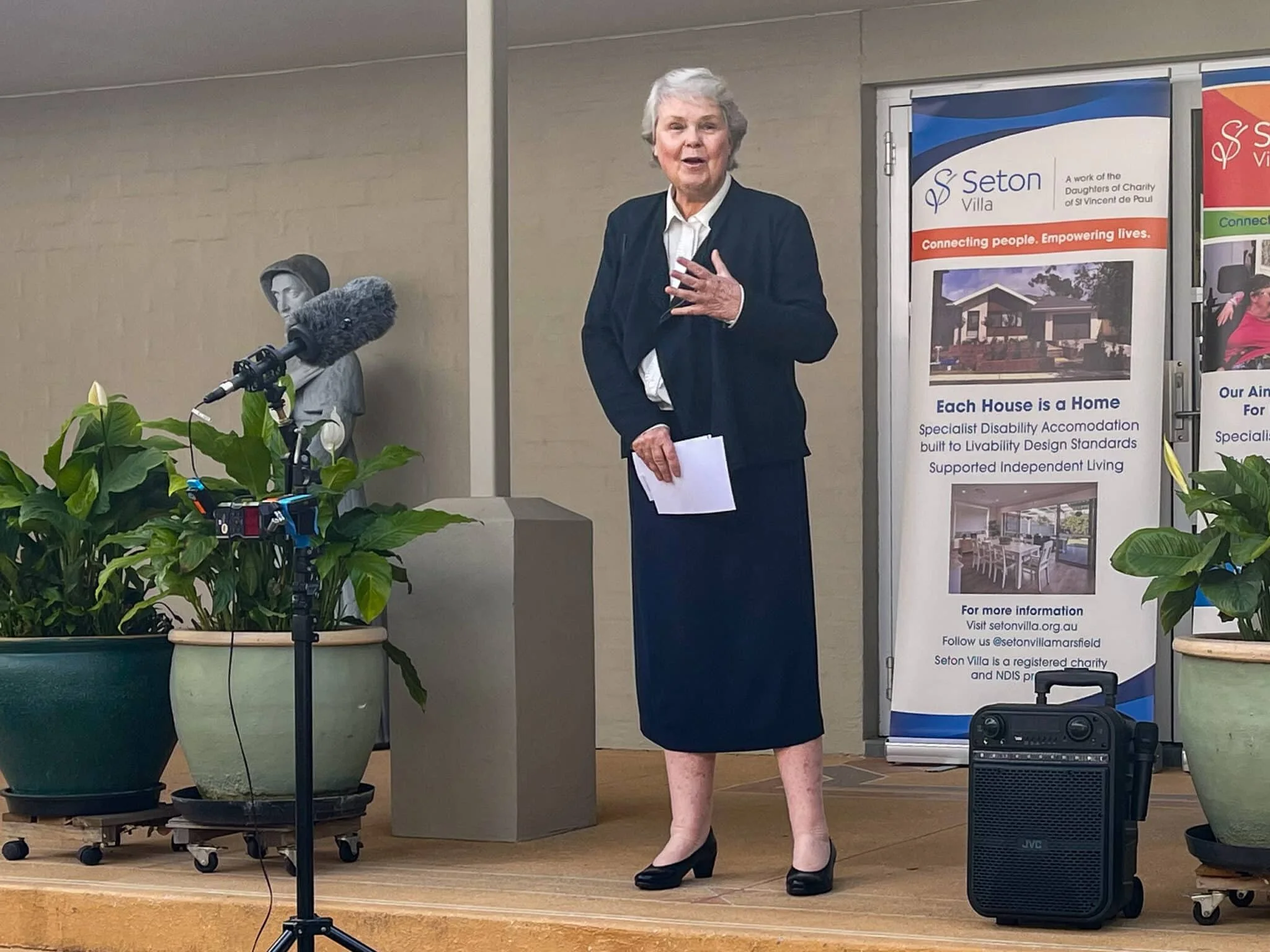
Sr Debra McCarthy DC gives the address at the 60th anniversary celebrations for Seton Villa. PHOTO Catholic Weekly/Supplied.
To mark the anniversary, residents, families, staff, volunteers, supporters and dignitaries gathered at Seton Villa’s original home in Marsfield on 23 August to celebrate its 60-year journey.
The celebration included the launch of Care, Empowerment and Choice: Celebrating 60 Years 1966-2026, a commemorative history tracing Seton Villa’s evolution and the residents, families, staff, volunteers and benefactors who shaped it.
The anniversary recognises the determination of the Daughters of Charity, who challenged community attitudes towards disability long before concepts such as person-centred care, community inclusion and supported independent living became mainstream.
When the Daughters began exploring a dedicated home in the late 1950s, families caring for daughters with intellectual disability faced few alternatives beyond large institutions.
After years of advocacy and fundraising, the Daughters secured government support and, on 23 August 1966, opened Seton Villa as a purpose-built home where young women could develop life skills, participate in their community and live with dignity and purpose.
Seton Villa Chief Executive Officer Peter Gardiner said the Daughters transformed disability support by refusing to accept the thinking of their time.
“Long before concepts such as person-centred care, community inclusion and independent living became standard government policy, the Daughters of Charity were already putting those principles into practice,” Mr Gardiner said.
“What began as a pioneering home for 24 young women has evolved into a modern, choice-driven network of contemporary homes.”
For many families, Seton Villa became much more than a place of care. Few illustrate that more powerfully than the Currans.
Jenny Curran, who was born with Down syndrome, moved to Seton Villa in 1968 after previously living at the Daughters of Charity’s Marillac House in Melbourne.
Her family became deeply involved with Seton Villa, helping with fundraising and its Parents and Friends Association and serving on its board.
Through the Bernard Curran Foundation, they also supported projects including the Jenny Curran Activity Rooms and, more recently, Jenny’s Place, a contemporary home named in Jenny’s honour. Jenny’s brother, Charles Curran, said Seton Villa gave families far more than peace of mind.
“We have many wonderful memories of Jenny at activities involving the Seton Villa families; woolshed dances, boat trips, picnics at Riverview, dinners at restaurants and clubs, art shows, and bingo; the list goes on,” he said.
He said Jenny’s presence was also a “binding force” within their family, bringing them together in their desire to care for and support her.
Founded in France in 1633 by St Vincent de Paul and St Louise de Marillac, the Daughters of Charity arrived in Australia in 1926 and established ministries in education, aged care, homelessness, parish life and disability support.
Seton Villa continued that tradition while adapting to changing expectations around disability. In 1984, residents moved from the original villa into shared homes throughout the Marsfield community, promoting independence and inclusion decades before community living became widely accepted.
Today, Seton Villa operates seven Specialist Disability Accommodation homes and provides Supported Independent Living services. Following a major redevelopment program, it has also expanded its services to support men with intellectual disability for the first time.
In the anniversary book, Sr Debra McCarthy DC said change had been a constant throughout Seton Villa’s history, driven by “the needs and dreams of residents and families” as well as best practice, government policy, funding models and research.
“We hope and pray that all who are part of this community of care will continue this story of hope, courage, creativity and love,” she said.
Mr Gardiner said Seton Villa would continue building on the Daughters’ vision by embracing creativity and innovation while ensuring people received high-quality support and opportunities to live fulfilling lives.
Sixty years on, Seton Villa remains a testament to a vision that began with a handful of families and grew into a community centred on dignity, independence and choice.
This article was published in The Catholic Weekly, the publication of the Archdiocese of Sydney.