
Nestled next to the Carmelite church Our Lady of Mt Carmel in Middle Park is one of the country’s most remarkable theological libraries, reports Melbourne Catholic.
Its collection ranges from Carmelite spirituality and Mariology to Jewish mysticism, Buddhist texts and Indigenous Australian spiritual traditions, attracting everyone from doctoral researchers to people simply searching for wisdom, meaning and a place to reflect.
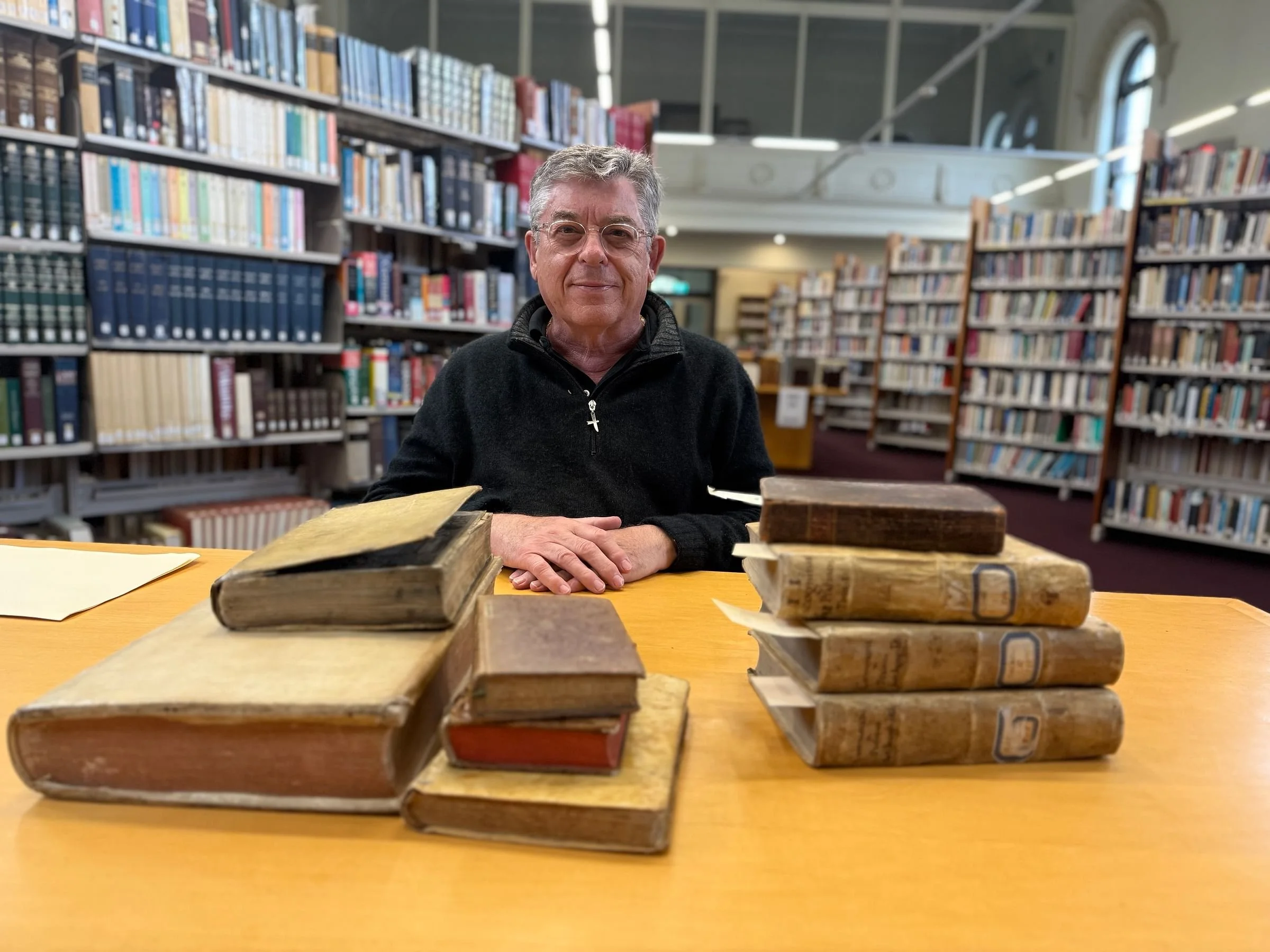
Carmelite priest Fr Paul Chandler, the long-standing director of the Melbourne library on top of being spiritual director of Holy Spirit Seminary in Brisbane. PHOTO: Melbourne Catholic.
Fr Paul Chandler O Carm, the library’s director, says it is an “extraordinary resource” of important heritage that the Carmelites would like to keep developing—but they need help to do so.
The Carmelites came to Melbourne from Ireland via Sydney in the late 19th century and built their first priory in 1886 in what is now the Brigidine Sisters’ convent on Beaconsfield Parade in Albert Park.
For many years, the library functioned largely as a seminary library, a theological collection intended for undergraduate study and formation. But as the Carmelites’ educational arrangements changed, they made a deliberate decision to specialise.
“We weren’t running our own self-contained seminary anymore. Our students were going to Yarra Theological Union, and there wasn’t really a need for us to maintain a general library,” Fr Paul says. “I became librarian at that time, and we decided that we just specialise in three areas.”
The decision was strategic, allowing the small library to build a distinctive collection in fields where its history, expertise and connections gave it an advantage.
Fr Paul believes the library’s collection of Carmelite material—known as Carmelita—may be the fourth largest collection in the world. It reflects the depth of the Carmelite tradition across theology, philosophy, mysticism, religious history, literature and the history of Christian spirituality.
“The Carmelite tradition is one of the most important traditions of spirituality in Christianity and Catholicism,” he says. “We’ve got really major contributors, especially Teresa of Ávila and John of the Cross, Thérèse Lisieux and Edith Stein.”
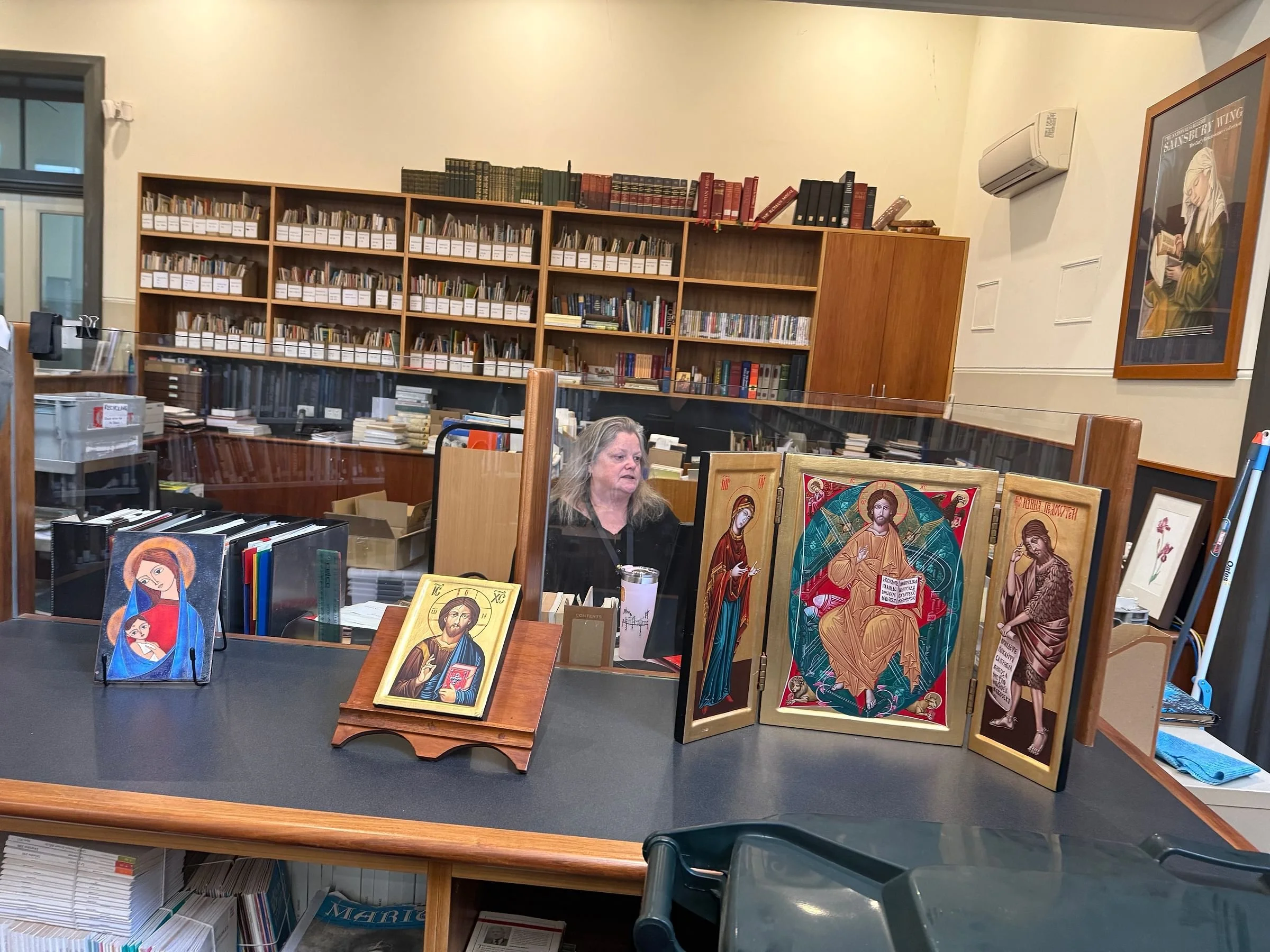
The librarian at the Carmelite Library, Jennie, pictured behind a display of icons. PHOTO: Melbourne Catholic.
The Carmelites’ intellectual heritage is also unusually international, and Fr Paul says the Middle Park library has works in many European languages, even Danish.
“Teresa and John are Spanish, of course, and if someone wants to do doctoral work, for example, on them, they really need access to the Spanish literature. A lot of that is really very important, and you can’t get that anywhere except here.”
The library’s holdings also make it possible to compare different religious traditions. A researcher can study Carmelite mysticism alongside other Christian writings, Jewish mysticism—it has a substantial collection—Buddhist or Islamic texts and Aboriginal spirituality.
“You can’t have a collection on spirituality that ignores the Franciscan school, or that ignores St Ignatius. So, we have collected in those areas, often quite well. A user can do comparative work here that they can’t do in even more specialised collections.”
The library’s users reflect a renewed interest in spirituality, but Fr Paul, who is also a historian, is cautious about spirituality detached from its own roots.
“Often people try to make it up again from the beginning, and we [are] offering a possibility for people to connect with what are actually very ancient traditions. We see this as a kind of source for connecting with the wisdom of the elders of different kinds,” he said.
The Carmelite library’s Mariology collection is becoming well known as more academic disciplines incorporate the study of Mary, Fr Paul says. “There’s a lot of interest in Mariology at the moment, actually, from various perspectives. Feminist historians have started to find it interesting. Then there’s cultural historians [interested in] devotion to Mary in Mexico and elsewhere.
“The Carmelites have, like many orders, devotion to the Virgin Mary, and we had already a fairly good Mariology collection,” he says. “Some years ago, it was boosted because an American Carmelite, Eamon Carroll—a very noted Mariologist on a world level—had an enormous personal library that he donated to us.”
The library has also tried to preserve forms of religious life and popular devotion that may no longer appear central to contemporary scholarship. This includes old devotional literature, the histories of women’s religious congregations and the publications produced by religious communities for their own members.
“We’ve been quite focused on building up not only a sort of research collection for scholars, but also retaining stuff that’s gone out of fashion, because there’s a whole bunch of stuff that used to be everywhere, and soon it’s going to be nowhere.”
The history of religious orders, the library director argues, is also a history of Australian society. The stories of women’s religious congregations, for example, can illuminate the changing roles of women, education, health care and social welfare.
The library is unusual in another respect: it is open to anyone. Fr Paul believes it may be the only theological library in Australia that anyone can come into.
The librarian, Jennie, says visitors arrive from a wide range of backgrounds to browse, read, ask questions or simply spend time in a quiet place.
“A lot of people are exploring their own spirituality. We have people coming from all different walks of life, just popping in to see what’s here and discovering that it’s got so much to offer them on so many different levels. They say, “Why didn’t I know this was here before?”’
“You take out a membership if you want to borrow, but everyone is more than welcome to come and sit and explore the collection and read and ask questions.”
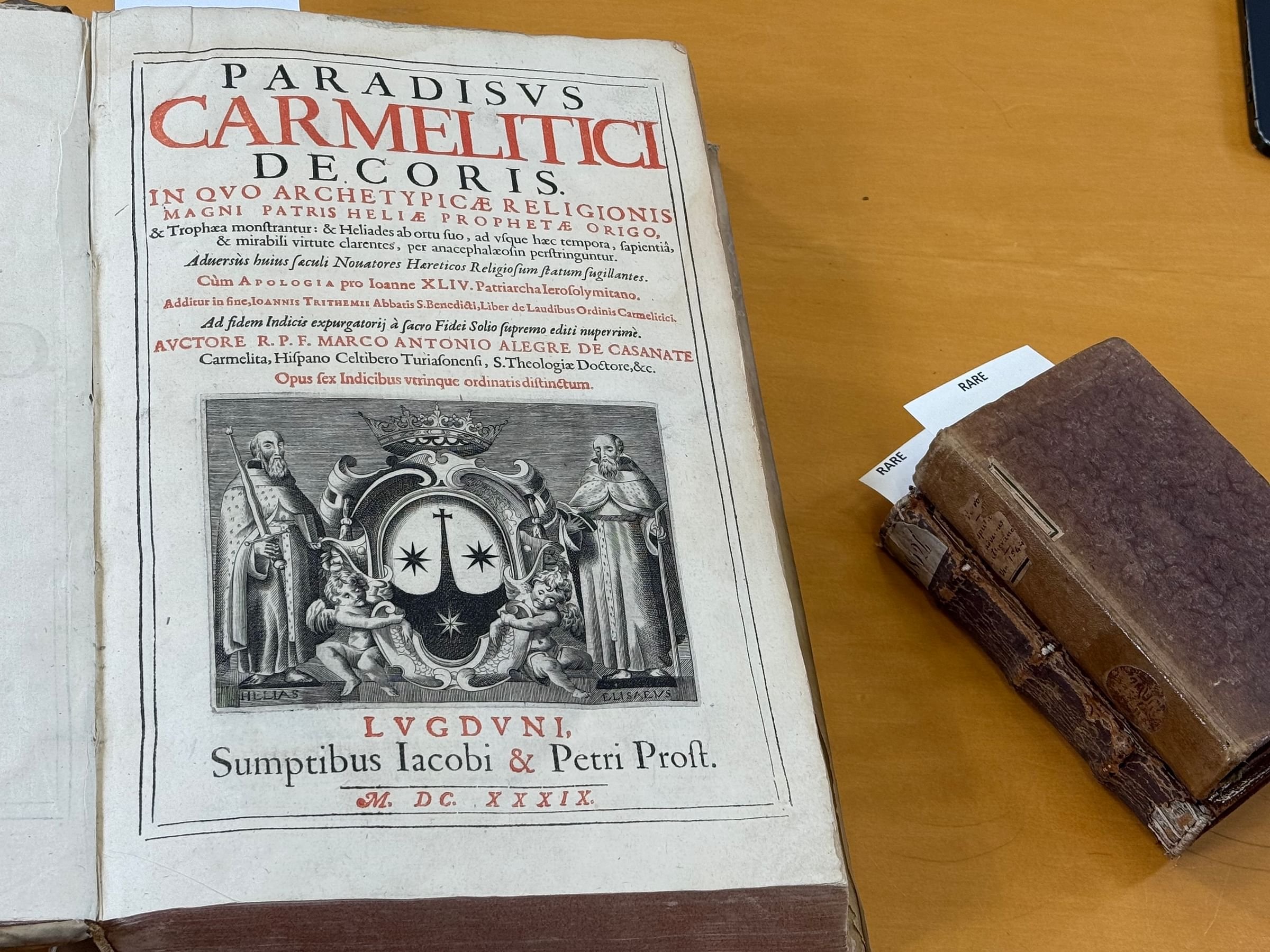
A 16th Century book Fr Paul says was banned by the Spanish Inquisition. PHOTO: Melbourne Catholic.
The Carmelite Library contains large collections on many saints, as well as on philosophy and theology.
For now, however, the library is struggling to maintain even its basic operations. Staffing has been reduced from four days a week to one, opening hours have been cut, and new acquisitions are increasingly difficult to make.
The problem, as Fr Paul describes, is that a collection is not a single project that can be completed within a year. Its value lies in continuity. Ideally, a substantial endowment would ensure that continuity, but the immediate aim is to keep the library open and accessible.
“We’ve got this extraordinary resource that has taken 140 years to build, and it’s at a very high level of excellence. We would just like to keep developing it and keep it available not only as heritage but also as kind of mission into the future.”
This is an abbreviated form of an article published in Melbourne Catholic, the publication of the Archdiocese of Melbourne.