
The work of ACRATH and St Vincent’s Health Australia (SVHA) in developing healthcare responses to modern slavery was recently shared on the global stage at the 8th United Nations Responsible Business and Human Rights Forum in Bangkok.
ACRATH Community Development Project Officer, Melissa Halliday, and SVHA Modern Slavery Liaison Officer, Group Procurement Specialist – Environment, Social and Governance, Tarang Jain, co-hosted a session called “Forced, Tricked or Trapped” to “Seen, Safe, Supported”.
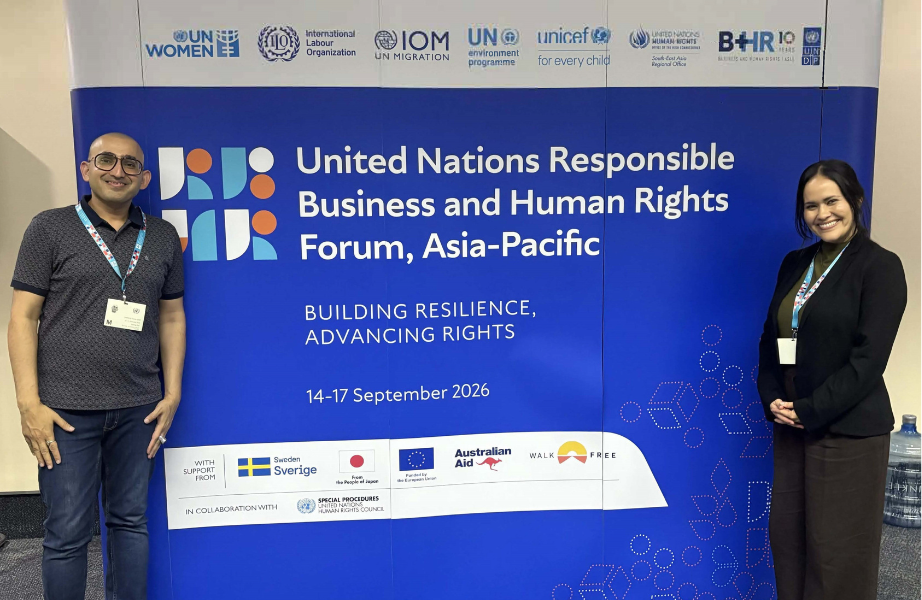
ACRATH Community Development Project Officer, Melissa Halliday, and SVHA Modern Slavery Liaison Officer, Tarang Jain, in Bangkok in September. PHOTO: ACRATH website.
The only healthcare-focused presentation offered at the forum, the session highlighted the importance of a survivor-led, trauma-informed approach to identifying exploitation in all sectors.
“Modern slavery survivors don’t announce themselves – they show up in emergency rooms, on factory floors and in supply chains, hidden in plain sight until it’s too late,” Mr Jain told participants. “Survivor-informed identification tools work equally well in a hospital ward as a factory floor.”
Ms Halliday said the session received a positive response, particularly the emphasis on involving survivors in the design of training modules and tools.
“There was a lot of talk about grievance mechanisms at the conference…we tried to highlight that if mechanisms are not survivor-centred or responsive to the realities of exploitation, they may fail to identify modern slavery within operations and supply chains,”she said. ” “In our experience, once the healthcare clinicians had training, they were seeing it so much more – in the project pilot, there was a 400 per cent increase in identifications once training and support was given.”
Ms Halliday said the benefits of ACRATH’s participation in the three-day forum, which was attended by more than 1,400 delegates from businesses and NGOs across Asia, were twofold.
“It was an opportunity to show how the principles, training and tools we used and developed for the project can be applied in a broader context,” she said. “And it was also a chance to participate in various sessions over the three days and see how Australia’s anti-slavery efforts are perceived at a regional and global level.
“Discussions and sessions covered mandatory human rights due diligence, worker rights, how to recognise forced labour in complicated supply chains and the ongoing need to reframe ethical business practices as advantageous opportunities rather than burdensome for a business”.
“One thing that came through several sessions was that there is a real opportunity for businesses to work alongside local NGOs to help strengthen worker rights – it reinforced the importance of cross-sector collaboration”
Ms Halliday said she was pleased to be able to reconnect with Tomoyo Obokata, the former UN Special Rapporteur on Contemporary Forms of Slavery who had visited Australia two years ago, in the earlier stages of the project to meet with SVHA and ACRATH to discuss the importance of a healthcare response to modern slavery, and subsequently attended the healthcare session in Bangkok in September,
Following the international forum, ACRATH continues to explore ways to further develop cross-sector collaboration in Australia and is hosting a national forum in early February, in collaboration with SVHA and the NSW Office of the Anti-Slavery Commissioner.
The forum is aimed at people with lived experience of modern slavery, health executives, clinicians, emergency staff, maternity carers, social workers, GPs, anti-slavery and intersecting community support services, unions and government representatives.
Recognise, Respond, Refer: Healthcare-led responses to modern slavery will be held on February 2, 2027, 9.30 am to 3.30 pm at the Catholic Leadership Centre, 576 Victoria Parade, East Melbourne. For more information, see page https://acrath.org.au/healthcare-response-to-modern-slavery/
To find out about sponsorship for people with lived experience of modern slavery, email Ms Halliday at awareness@acrath.org.au before December 30.
This article was published on the website of ACRATH (Australian Catholic Religious Against Trafficking in Humans)